
A “near-Earth” asteroid is not automatically a threat. NASA and partner observatories repeatedly measure these objects so scientists can refine their orbits, predict close approaches and evaluate whether any meaningful impact risk exists.
At a glance
- NASA’s Planetary Defense Coordination Office organizes the agency’s detection and tracking work.
- JPL’s Center for Near Earth Object Studies calculates precise orbits and close approaches.
- Potential risks are checked repeatedly as new observations improve the orbit.
Discovery begins with observations
Survey telescopes scan the sky and compare images taken at different times. A moving point of light may be reported as a possible asteroid or comet. Follow-up observations are essential because a short observation arc leaves more uncertainty about the object’s path.
How an orbit becomes more precise
NASA’s Center for Near Earth Object Studies, managed at the Jet Propulsion Laboratory, calculates high-precision orbits for known near-Earth objects. As observatories provide additional measurements, the predicted orbit can become more accurate and the range of possible future positions can shrink.
What the Sentry system does
Sentry is an automated monitoring system that continually scans the current asteroid catalog for possible Earth impacts over the next century. A listing represents a calculated possibility that requires interpretation; it is not a prediction that an impact will occur. Many early possibilities disappear after new observations reduce uncertainty.
Why close approach does not mean collision
Space distances are enormous, and an object can pass comparatively close to Earth while remaining far beyond the Moon. Size, distance, speed and orbital uncertainty all matter. The best place to check a viral claim is NASA’s current asteroid-watch information rather than an isolated screenshot.
Sources
AskNovus links readers to the official sources so the underlying information can be reviewed directly.
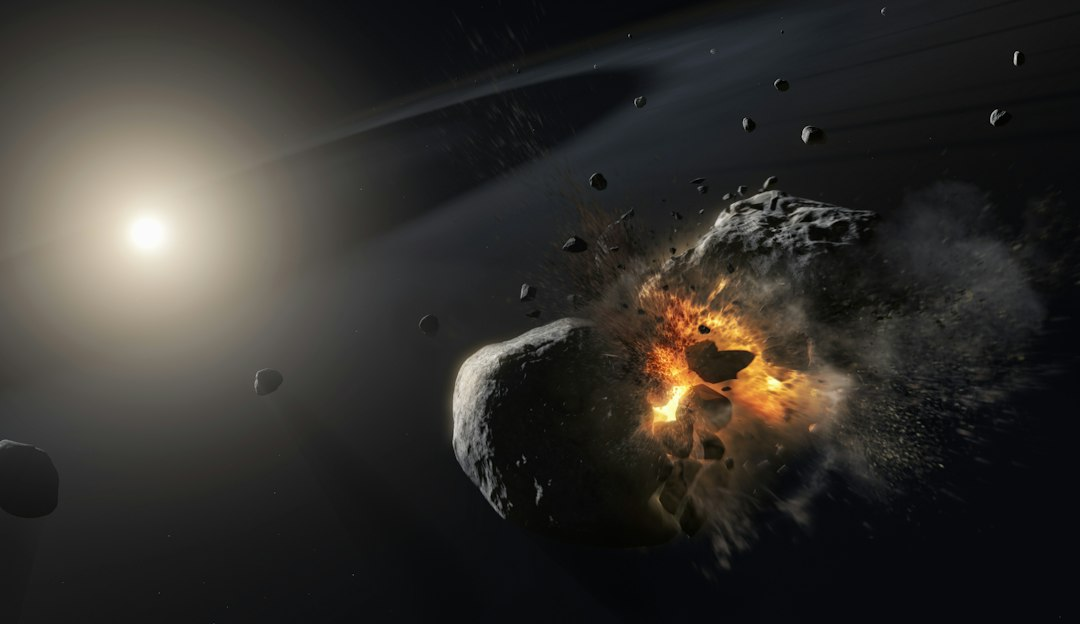
This is an original AskNovus explanation based on the linked sources. It does not reproduce a publisher’s article. Featured image: NASA Hubble Space Telescope via Unsplash. Information may change after publication; check the official sources for updates.
[…] The next concrete milestone is the uncrewed Starliner-1 flight. Its timing and results will determine what NASA can conclude about the propulsion changes. For a separate look at how the agency tests and updates assessments of space hazards, read our guide to how NASA tracks near-Earth asteroids. […]